
At Innovations in Dementia, we have recently helped facilitate another post-diagnostic ‘A Good Life With Dementia’ course in Carmarthenshire, West Wales.
A Good Life With Dementia a course FOR people with dementia co-created and co-delivered BY people with dementia. It is a space for people with the actual diagnosis to come together, address fears and concerns and hitherto unanswered questions. It is also a space to learn amongst peers (eg that you don’t actually lose all your brain cells in one go!), discover tips, realise that life still goes on and hopefully recover from the huge blow of a diagnosis of dementia.
‘It felt like suddenly being dropped twenty floors in a lift’
As ever there were many highlights from the latest course in Ammanford, Carmarthenshire, where 18 people gathered over 6 weeks to laugh, cry, learn, share, create new bonds and build lasting relationships as well as lay the foundations for a new peer group that will meet regularly now.
In this blog I want to focus on our discussions around what dementia is. Google ‘what is dementia?’ and you’ll get the dictionary definitions of a syndrome, a range of diseases of the brain followed by an explanation of how it might manifest itself in terms of how people with dementia might behave or the symptoms they might experience.
Yes, we all know the dictionary definition and then we get told about types and prevalence. However, a dictionary definition or an explanation on a website about what you might do or what you might lose rarely connects with the daily reality of many. Of course, we address the reality of progressive death of nerve cells in the brain (keeping it as simple as that) but we also ask on the Good Life course, ‘What is living with dementia like for you?’
I’d like to share now what the latest cohort of learners in West Wales shared – you certainly won’t get this in the dictionary.
What Dementia Means To Us (in no particular order)
Dementia is
- Being given a huge blow at diagnosis
- Frustration in having to apply for a driving license year on year, when in the meantime I have learnt to fly!
Dementia is loss
- ‘I want to do things but I can’t’.
- ‘My car is sat on the driveway as a ‘reminder of what I can’t do’.
Dementia is about being the last to know
- ‘It comes, then you think that’s not you, but it is.’
Dementia is a change in other people!
- ‘Others won’t let me do anything!’ (cue lots of knowing looks!)
- ‘It’s feeling as if I’m the strange one’. Not at the Good Life course! How refreshing to finally be amongst a group of normal people here!!
- Others can be very understanding and they make allowances and offer more help. But…
- ‘Sometimes they do too much for me and speak over me as if I’m an idiot’
Dementia is weighing up whether to share your diagnosis all the time.
- It’s unfair that other people should make you feel you should withdraw or refrain from speaking.
Dementia is constantly having to be on guard – how exhausting!
Dementia is fear and uncertainty
- Will we ever see future plans and events realised or understand them when they are?
- What will I be like? How long have I got?
- How will my dementia progress, at what rate and what might be in store?
The short answer to the last question is probably, ‘Who knows?’ but how fantastic that this short discussion – maybe 40 minutes or so – allowed the participants themselves to reflect on what can help combat that Malignant Social Psychology, as Kitwood put it. Coming together as peers meant that…
- Here we are experiencing the power of being amongst people in the same boat
- Here we are giving emotional support and encouragement as we each share openly and honestly some deeply personal feelings.
- Here we are laughing at ourselves
- Here we are building a whole new web of social connections.
‘I’ve met more people socially since my diagnosis than I ever did before’.
- Here we are learning off each other about the nature of dementia, about our rights to continue as family members and active citizens.
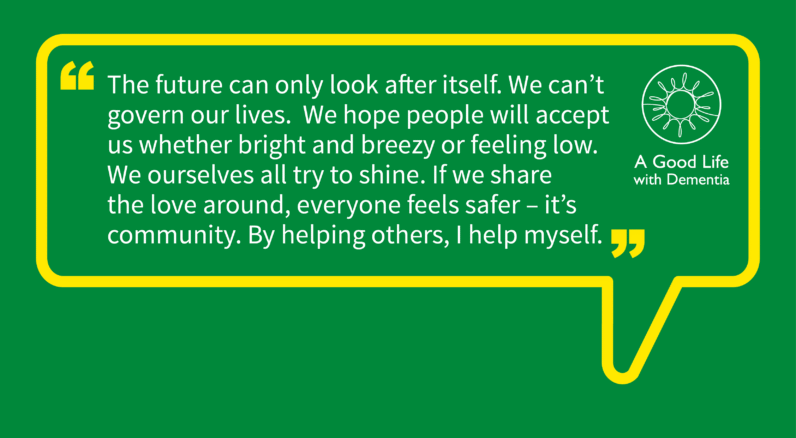
‘The future can only look after itself. We can’t govern our lives. We hope people will accept us whether bright and breezy or feeling low. We ourselves all try to shine. If we share the love around, everyone feels safer – it’s community. By helping others, I help myself’
(Cue rapturous applause!)
Aah, so THAT is what dementia is! Yes, it’s an organic process going on in the brain but it is also a change in others, it’s a compromise of voice, choice, control, identity, agency. These are all things that Kitwood highlighted, but how much more powerful to hear this from those actually living with the diagnosis.
So please don’t just limit yourselves to the dictionary definitions and generic symptoms list. Ask the experts! Ask, so what happens to you? How have people changed towards you? How was it being told you have dementia? What is your message to others going through a similar experience? What is your message to the wider world?
The space provided by the Good Life model for people with a diagnosis to share and come together uninterrupted, uncorrected, unblamed gives us a much clearer understanding of what is happening, of what people are experiencing and more importantly what we can do about it.
Don’t worry, the group didn’t keep all this to themselves! Each Good Life course has produced its own ‘manifesto’, detailing what participants have learnt, what they expect of the wider world and powerful calls to action. On top of that each Good Life course has led to the creation of new groups of engaged interested and active (and increasingly activist) people with dementia.
If you want to find out more about A Good Life With Dementia you can:
- Watch the 5 minute video here https://www.youtube.com/watch?v=XRS4Aha068Y
- contact Damian@myid.org.uk
- Explore the work led by the University of York researching A Good Life With Dementia here And here
Damian Murphy
Co-Director, Innovations in Dementia
November 2025