Building the Evidence

Learning led BY people with dementia FOR people with dementia – building the evidence.

Here at Innovations in Dementia towers (well, our various sheds and home office spaces) we have known for a long time now of the potential of people with dementia to lead on learning, development, research, and support in dementia.

We know this particularly through the nearly 20 years of practical work we have done working alongside people living with dementia. This includes the Dementia Enquirers work and the DEEP network comprising around 100 independent peer groups of people with dementia meeting regularly across the UK.

We have helped co-facilitate scores of gatherings, conference presentations, workshops, project advisory groups and training, all led by people with dementia, thus broadening the platform for the voices of people with dementia to be heard – and heeded.

Another thing we do has been to introduce and facilitate the ‘A Good Life With Dementia’ model. It is the growing evidence of the impact of this peer-led, post-diagnostic course that I wish to focus on in this blog.

A Little History

‘A Good Life With Dementia’ as a specific practical programme emerged around 2019, but it was born over the last 20 years of our recognition that there should be a space people with dementia to gather, share, offload, and to seek answers to questions such as Richard’s,  ‘Why is there a course for carers, when I’m the one with dementia?’

Alongside a colleague we decided to create a post diagnostic course for people with dementia ourselves. We were very proud of what we put together. We called it ‘My Dementia’ but after 5 minutes on session one with a small group of individuals diagnosed with dementia, we threw our entire course content out of the window.

Despite our good intentions, we had missed the mark by a long way in terms of where people were at. WE had decided what people with dementia should learn! Next time we would involve people with dementia.

We worked with the Minds and Voices DEEP group in York. We began a discussion and within minutes they had the course content sorted! It was based on the messages they wanted to give to their more recently diagnosed peers. It aimed to restore some hope and a boost to confidence after the massive blow of a diagnosis. It aimed to give people the message that life goes on and that they are not alone. It aimed to support people to realise they still have rights as a citizen, family member and individual to participate, contribute and belong.

The group members themselves led the course sessions. Shared learning amongst equals is a beautiful thing to see. From the very first A Good Life With Dementia course we knew it worked. Who better to learn from than those who’ve been there and got the T-shirt? Where else do you need to be than amongst people who can truly say ‘I know how you feel’ if you get upset?

The model has been repeated widely – each time a new Good Life course is co-created locally by local people with dementia. You can ask the STAND peer group who facilitate their own Good Life course across the Kingdom of Fife. You can ask the London Borough of Hammersmith and Fulham or the West Wales Regional Partnership Board and you can ask the East Riding of Yorkshire Council where over a dozen Good Life courses have been co-created and delivered.

People there will all tell you about the growth in hope and confidence and the recovery from the blow of a diagnosis that everyone experiences. They will tell you of the warmth and belonging and new mutually supportive relationships that have been created amongst peers. They will tell you of the great new opportunities to come together as peers and say, ‘coming here is like everyone wrapping their arms around me in a big embrace’. They will tell you, ‘It’s like that feeling as a child when you whoosh down a slide!’

We’ve seen people grow in confidence, speaking up, coming up with calls to action and realising that, ‘in this room each week, just like at home, I no longer struggle to get the words out’.

It’s an absolute privilege to be present amongst peers with dementia, where, once care partners have been invited to leave the room, a delicious silence descends and the shared learning begins.

The murmur in the breaks of people with dementia chatting independently helps move us away from those images of people with dementia sat in silence around the edges of a room as passive recipients of care waiting to be done to. It takes us to a new reality of people with dementia as a resource – hitherto relatively untapped.

That’s what we see and have known for a while but don’t take our flowery words for it. We’ve been working with York University over the last 3 years to capture what in the Good Life model works in theory to bring such change. We can now announce that a peer-reviewed journal article has now been published setting out the findings of the study, which you can read by following the link below.

Gridley, K., Wilberforce, M., Mann, R., Tucker, L., Casey, B., Clarke, C., Creavin, S., Donaldson, I., Gordon, H., Murphy, D. and Pearson, M., 2026. The Good Life with Dementia approach: A realist-informed qualitative study of a peer-tutored course, co-produced with and for people living with dementiaPloS one21(6), p.e0349444. https://journals.plos.org/plosone/article?id=10.1371/journal.pone.0349444

What’s more, the follow-on feasibility study is now well underway, see https://sscr.nihr.ac.uk/research/dementia/good-life-with-dementia/. It will test out the Good Life model across diverse communities in Bristol, Manchester and Sheffield.

Specific Taking Part Opportunity

If you live with a diagnosis of dementia in the Manchester, Sheffield or Bristol areas, you could be a participant in this study either as a learner on A Good Life course or as member of the study control group in your area. Courses have already been put together by local people with dementia in each area and will be delivered later this year.

Please contact kate.gridley@york.ac.uk

If you are interested in bringing A Good Life With Dementia to your area or

If you are interested in training as a facilitator for A Good Life With Dementia, then contact Damian@myid.org.uk

Damian Murphy
Co-Director, Innovations in Dementia

June 2026
You won’t find this in the dictionary

At Innovations in Dementia, we have recently helped facilitate another post-diagnostic ‘A Good Life With Dementia’ course in Carmarthenshire, West Wales.

A Good Life With Dementia a course FOR people with dementia co-created and co-delivered BY people with dementia. It is a space for people with the actual diagnosis to come together, address fears and concerns and hitherto unanswered questions. It is also a space to learn amongst peers (eg that you don’t actually lose all your brain cells in one go!), discover tips, realise that life still goes on and hopefully recover from the huge blow of a diagnosis of dementia.


‘It felt like suddenly being dropped twenty floors in a lift


As ever there were many highlights from the latest course in Ammanford, Carmarthenshire, where 18 people gathered over 6 weeks to laugh, cry, learn, share, create new bonds and build lasting relationships as well as lay the foundations for a new peer group that will meet regularly now.

In this blog I want to focus on our discussions around what dementia is. Google ‘what is dementia?’ and you’ll get the dictionary definitions of a syndrome, a range of diseases of the brain followed by an explanation of how it might manifest itself in terms of how people with dementia might behave or the symptoms they might experience.

Yes, we all know the dictionary definition and then we get told about types and prevalence. However, a dictionary definition or an explanation on a website about what you might do or what you might lose rarely connects with the daily reality of many. Of course, we address the reality of progressive death of nerve cells in the brain (keeping it as simple as that) but we also ask on the Good Life course, ‘What is living with dementia like for you?’

I’d like to share now what the latest cohort of learners in West Wales shared – you certainly won’t get this in the dictionary.


What Dementia Means To Us (in no particular order)

Dementia is

  • Being given a huge blow at diagnosis
  • Frustration in having to apply for a driving license year on year, when in the meantime I have learnt to fly!

Dementia is loss

  • ‘I want to do things but I can’t’.
  • ‘My car is sat on the driveway as a ‘reminder of what I can’t do’.

Dementia is about being the last to know

  • ‘It comes, then you think that’s not you, but it is.’

Dementia is a change in other people!

  • ‘Others won’t let me do anything!’ (cue lots of knowing looks!)
  • ‘It’s feeling as if I’m the strange one’. Not at the Good Life course! How refreshing to finally be amongst a group of normal people here!!
  • Others can be very understanding and they make allowances and offer more help. But…
  • ‘Sometimes they do too much for me and speak over me as if I’m an idiot’

Dementia is weighing up whether to share your diagnosis all the time.

  • It’s unfair that other people should make you feel you should withdraw or refrain from speaking.

Dementia is constantly having to be on guard – how exhausting!

Dementia is fear and uncertainty

  • Will we ever see future plans and events realised or understand them when they are?
  • What will I be like? How long have I got?
  • How will my dementia progress, at what rate and what might be in store?


The short answer to the last question is probably, ‘Who knows?’ but how fantastic that this short discussion – maybe 40 minutes or so – allowed the participants themselves to reflect on what can help combat that Malignant Social Psychology, as Kitwood put it.  Coming together as peers meant that…

  • Here we are experiencing the power of being amongst people in the same boat
  • Here we are giving emotional support and encouragement as we each share openly and honestly some deeply personal feelings.
  • Here we are laughing at ourselves
  • Here we are building a whole new web of social connections.


‘I’ve met more people socially since my diagnosis than I ever did before’.

  • Here we are learning off each other about the nature of dementia, about our rights to continue as family members and active citizens.


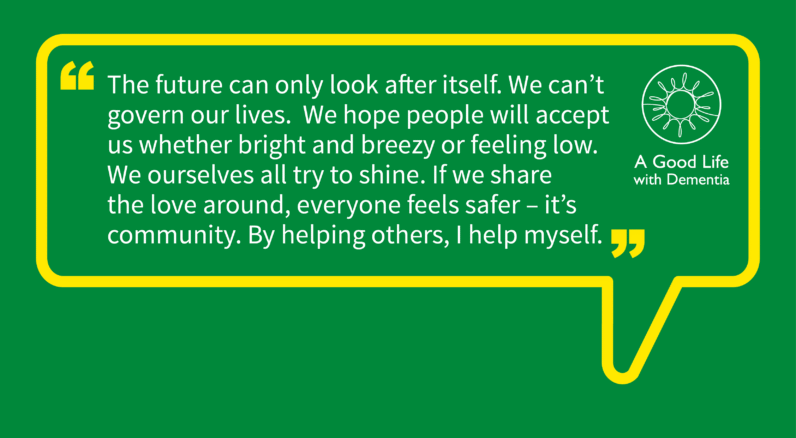
‘The future can only look after itself. We can’t govern our lives.  We hope people will accept us whether bright and breezy or feeling low. We ourselves all try to shine. If we share the love around, everyone feels safer – it’s community. By helping others, I help myself’

(Cue rapturous applause!)

Aah, so THAT is what dementia is! Yes, it’s an organic process going on in the brain but it is also a change in others, it’s a compromise of voice, choice, control, identity, agency. These are all things that Kitwood highlighted, but how much more powerful to hear this from those actually living with the diagnosis.

So please don’t just limit yourselves to the dictionary definitions and generic symptoms list. Ask the experts! Ask, so what happens to you? How have people changed towards you? How was it being told you have dementia? What is your message to others going through a similar experience? What is your message to the wider world?

The space provided by the Good Life model for people with a diagnosis to share and come together uninterrupted, uncorrected, unblamed gives us a much clearer understanding of what is happening, of what people are experiencing and more importantly what we can do about it.

Don’t worry, the group didn’t keep all this to themselves! Each Good Life course has produced its own ‘manifesto’, detailing what participants have learnt, what they expect of the wider world and powerful calls to action. On top of that each Good Life course has led to the creation of new groups of engaged interested and active (and increasingly activist) people with dementia.

If you want to find out more about A Good Life With Dementia you can:


Damian Murphy
Co-Director, Innovations in Dementia

November 2025


Our response to “The Long Goodbye” advert

It has been a few weeks now since the Alzheimer’s Society launched the video based around the message that ‘people with dementia die again and again and again’

It has been concerning to see what has unfolded in recent weeks because of this advert.

It has caused a lot of distress, anguish and fear, and has polarised people who all feel strongly about dementia into different groups who are now fighting each other and undermining each other’s experiences and work.

We have seen ideas and words used to describe people with dementia that we have not heard for decades. In short, there has been a lot of collateral damage. To read some of the comments on social media, one would imagine that those who promote ideas for living well are utterly delusional about what might lie ahead. On the contrary, everyone with whom we work has scars on their back from dementia – and from the stigma that goes with it – something which this advert will not help with, and in fact makes much, much worse.

The main problem is not to be found in the words of the carer in the advert, but in the voice of the narrator that takes over towards the end, reminding us that “people with dementia die, die and die again.”

This is a critical line which is spoken on behalf of Alzheimer’s Society. It shifts the position that ‘people with dementia die again and again’ from the experience of the son in the advert to that of Alzheimer’s Society. It changes the message from a carer’s perspective to, in the words of one of Alzheimer’s Society’s tweets, ‘The Unvarnished Truth’.

We suggest that the story in the advert is not THE unvarnished truth, it is AN unvarnished truth – but by putting those words into the mouth of the narrator, it becomes THE truth, especially in the minds of the target audience – those who know little about dementia.

Since the advert launched, we, and many of those with whom we work (and with whom the Alzheimer’s Society have worked) have come under sustained attack on social media for sugar-coating dementia. Protests at the impact of the advert been dismissed as overly dramatic or even opportunistic. The same attacks have also been made upon carers who voice their opposition, or who have said that their experiences were different.

The Alzheimer’s Society argue that the message of the advert is not meant literally, and that it is a metaphor……and yes, of course it is a metaphor, but a metaphor for what? For loss? For social death, for death of self, of one’s place in the world, of one’s identity? Unfortunately, people hearing the advert are not given a 16-page guide explaining the meaning or the rationale. All many have heard is that they are dead. Metaphorically of course.

We have tried really hard to be balanced in everything we have said publicly about this advert, and in reaction to people in the DEEP network. When we invited DEEP groups to send their comments in for us to collate to send to the Alzheimer’s Society we made it very clear we made no assumptions about how people would feel about the advert.

There were a handful of people who felt favourably about the advert, and many who didn’t. For ease, we categorised people’s comments. Many people talked about the lack of balance in the advert and the potential to deepen a stigma which is already pervasive.However, by far, the majority of responses report fear, sadness, and distress.

These were comments mostly from carers of people with dementia.

We have seen very visceral (and sometimes very concerning) reactions, to the advert, across social media platforms from carers and people with dementia. These include at least two reliable reports of people with dementia expressing suicidal ideation as a result of seeing the advert.

So our question to the Alzheimer’s Society is this:

Can you, an organisation that offers help and hope to people with dementia and carers, justify any collateral damage to part of your constituency to further your message? 

We know that Alzheimer’s Society has an unenviable task to be there “again, and again, and again” for all people with dementia and carers at all stages of dementia.

But this advert undermines its work and funded research that has driven work to challenge stigma, increase awareness, encourage diagnosis and support people to live as well as they can.

Alzheimer’s Society is a large and far-reaching organisation. The framing in this advert will influence how people with dementia feel about their diagnosis, how families think about dementia and how the dementia sector treats people with dementia, for decades.

We have two simple suggestions:

  • Edit the very end of the advert so that it is not Alzheimer’s Society stating that people with dementia ‘die, die and die again.”
  • Engage the dementia sector in discussion and explanation. We, therefore, encourage Alzheimer’s Society to look at the offer made by Dementia Community to use them as a conduit to engage with the sector.

We hope Alzheimer’s Society receives our perspective in the spirit in which it is delivered – as we all know that it is better when we understand each other and work together.


Fascination

Above quote from the York Minds and Voices Dementia Strategy.

At the UK Dementia Congress in November last Year, Professor Claire Surr delivered the Tom Kitwood memorial address. It was based on her in depth study on ‘What works in dementia education and training’.

It’s a great piece of work. Professor Surr rightly highlighted the importance of context in dementia training. She mentions the need for a learning culture to be present. (You can watch the full address here)

It very much chimed with a lot of the questions I have been asking myself over the years about how and why training works in some places and not others and about how to create more of a culture of learning.

Some time ago I was asked to be on a sub-group to look at the ‘learning well’ element (what else?!) of a local dementia strategy. I got the sense we were expected to come up with a long list of who should know what at what level – a sort of matrix if you like. It’s the sort of stuff that is out there in abundance along with tiers of learning, workbooks and lots of certificates. I just knew putting something like that together would not make any significant difference and would frankly bore me to tears.

Back in November at the UK Dementia Congress a ‘Question Time’ panel were asked their thoughts on dementia training being mandatory for all. ‘Oh yes!’, people cried. ‘Oh no!’ I thought.

I imagine all those young people, fresh into the job being given workbooks and targets hanging over them. Such training has, I’m afraid, become part of the ‘processing’ of new staff and satisfying regulatory requirements rather than anything that might serve to retain staff or to create a sense of belonging or ownership of learning – A culture of learning if you like.

I can’t be the only person who finds working in and thinking about dementia care absolutely fascinating. So, how we might feed and fuel fascination in the area of dementia learning and development is exactly what we focussed on in our ‘learning well’ sub-group.

You see, the mandatory element shouldn’t be on the staff to churn out buzzwords on workbooks or to sit for hours in front of online learning modules. Rather the obligation should be on organisations and wider communities to offer an engaging, fascinating suite (or a buffet) of learning opportunities for ALL. That way, anyone can pick and choose to access whichever learning opportunity fascinates them. This promotes an ownership of learning i.e. people being invited to learn stuff rather than being told to.

There is a whole range of fascinating topics and resources out there to make a buffet worth gorging on!  Many, if not all of these, can be updated, re-designed and delivered with and by people with dementia too.

Only last week we delivered a 2-hour learning session to 20 local community health and wellbeing staff. By ‘we’ I mean myself and 3 people living with dementia. ‘I’ve learnt more in the last two hours than I have in the last 4 days when I spent all day looking at online tick-box, mind numbing so-called training,’ said one participant. Why, because our session, entitled ‘Engaging in Everyday Situations’ was fascinating. The first-hand testimony was powerful, frank, challenging and informative. It stuck.

If you want to ensure that you lay out a buffet that meets the learning needs of all, there are 3 questions I believe need answering:

  1. What is it that people with dementia want others to know and learn? So, it begins as ever with people with dementia at the heart of the work
  2. What is it that people with dementia and their care partners and supporters want to learn themselves? and…
  3. What is it that organisations, staff and all other stakeholders say they want to know and learn?


I think up to now, talk of a culture of learning has focused almost exclusively on question 3 – the learning needs of staff and their organisations. However, to create fascinating relevant learning opportunities, you cannot ignore questions 1 and 2.

So, please, collaborate, not only with people living with dementia and their supporters, but also with other local stakeholders in your area.

Create and sign up to a ‘commitment to learning’ across your patch.  We are currently working with the London Borough of Hammersmith and Fulham to do exactly that and looking to do some of the following as part of what they are calling their Dementia Academy

  • Involving local residents with dementia in the design and delivery of learning and development activities across the Borough
  • Opening training to each other and families and people with dementia too
  • Providing access to learning events across disciplines and organisations
  • Hosting an ongoing learning and development conversation to share ideas and reflect on practice and issues across the Borough
  • Pooling of training budgets and resources
  • Provision of ongoing group supervision/action learning opportunities for staff (from across all sectors) engaged in what can be intense and intensely stimulating work.


So, if you want to continue the discussion and would like support in answering those questions one and two from above, do not hesitate to get in touch with us. We’ll be fascinated!

Damian Murphy
Co-Director, Innovations in Dementia


Let’s be Clear

I had just moved into a new house in Tottenham. There was a Large Swedish Home Furnishings shop nearby, and I was keen to try out the idea of flat-pack furniture for the first time.

I’d get back with my large box. Unpack it.

Lay out all the bits of wood, screws, plastic plugs and metal thingamyjigs.

Then I’d open the instructions.

That’s when my problems would start. The instructions appeared to have been written in Swedish, then translated into Urdu, then from Urdu into English.

By someone who spoke no Urdu, no Swedish, and certainly no English.

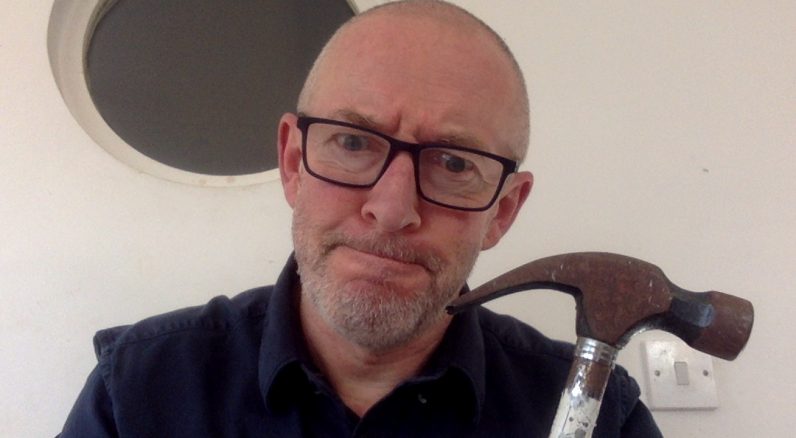
Routinely my best efforts would result in tangled mess of ill-fitting parts that were destined to fall victim to my heartfelt DIY motto:

“If at first you don’t succeed………smash it to bits with a hammer”

In fairness to Large Swedish Home Furnishings Companies – their instructions have improved enormously in recent years. I can honestly say I haven’t smashed any of their stuff to bits with a hammer for, ooh, ages.

I wish more companies would listen to their customers complaints though, and really think about how they explain things.

After all, we are much more likely to buy something or use a service if we understand what it is and how to use it. You’d imagine companies and organisations would be falling over themselves to be clear in their messages.

But no. From bus timetables to self-service checkouts in supermarkets we are bombarded by messages and instructions that seem to be purposely designed to make our day just that little bit harder.

“UNIDENTIFIED ITEM IN BAGGING AREA”!!!

Excuse me?

“UNIDENTIFIED ITEM IN BAGGING AREA”!!!

Aside from the merciless torturing of the English language, what on earth does it mean, and what I am meant to do about it?

Of course, most of the time we can work out what things mean.

We just shouldn’t have to anywhere near as much as we do.

…..and it’s not just one thing of course – as we go through our day we encounter these little challenges over and over again – each one of which adds another little bit to our ‘cognitive load’. Each makes our day that little bit harder, bit by bit, message by message. They might seem like little things, but together they weigh us down.

The onset of dementia can make it even harder for people to translate bad information. This can make it harder to people to get out and about, and to do many of the things the rest of us take for granted.

These can be very real barriers for people.

  • The badly designed bus timetable that meant someone got on the wrong bus and got lost, or went home having failed to work out what to do next.
  • The shrieks of outrage from the self-service checkout, devoid of either meaning or direction that sent the would-be customer scurrying out of shop, mission unaccomplished.


We know what can happen when we begin to struggle, or fail in certain tasks. It means we are less likely to risk failing again, and stay home where it is safe. We disengage.

Many people with dementia have told us that a single incident like this can send them into a tailspin and have a huge impact on their confidence in their ability to interact with the world. They disengage.

How much easier would life be for all of us of if things were just a little bit clearer?

This is why, about ten years ago we wrote some basic guidelines on writing better information for people with dementia.

Since then we have used them to produce dementia-friendly materials for lots of events and organisations, from conferences to lay summaries of academic papers.

What is very striking though is that not only do people with dementia find these versions easier, so does everyone else.

We first realised this when we produced a dementia friendly timetable for a conference. We had to go across the road to a photocopying shop for more copies as they had all been snaffled up in preference to the main conference timetable.

We can see the impact we can have by making things just a little easier for everyone.

We have been rewriting and expanding these guidelines over the last few years. We worked with the Dementia Diarists DEEP group, and created an online survey which was completed by 123 people.

You will find these new guidelines here:

https://www.innovationsindementia.org.uk/wp-content/uploads/2023/01/accessible-writing-guide.pdf

We believe that people with dementia have unique insights and understanding of how to make the world an easier and better place for everyone.

My dear friend Lynda Hughes once said to me “people with dementia have a wisdom that I don’t see anywhere else. They can save the world”.

Sometimes as the messages from mobile phones, computers, video screens and the Daleks inside self-service checkouts swarm around my head I am reminded how right she was.

Now where’s my hammer?

Steve Milton
Co-director, Innovations in Dementia


January – a time for imaginings at Innovations in Dementia

A New Year can often feel like a time of change. We write commitments and resolutions to   be more active, develop ourselves, lose some things, gain others, transform into the person we once were or would like to be. But the Almanac I received as a kind Christmas gift says that, contrary to popular belief, January is a time for rest, reflection and imaginings, not a time for new beginnings. It gifts us with time to plan and explore possibilities for the coming year.

In one way, Innovations in Dementia enters the New Year at a time of change. We said the fondest of farewells at the end of 2023 to Rachel Niblock who was the DEEP co-ordinator since 2015, and Philly Hare who retired after 8 years as a co-director. New adventures beckon both of them. We remain a small, but steadfast team of three, a number we are familiar with from the early days at Innovations in Dementia. A triangle of Damian, Steve and Rachael – apparently one of the strongest geometric shapes (a triangle that is, not a Damian, Steve and Rachael!)

So, although it may feel like a time of change, we are actually standing strong and stable to continue the work of Innovations in Dementia. Here is a little look to our plans for 2024.

  • We are perhaps best known for hosting the DEEP network – the UK wide network of over 80 groups of people with dementia. It remains our privilege to continue to provide the scaffolding to this independent, diverse and rights-based network.
  • We also want to build on the success of the Dementia Enquirers programme and find other opportunities for people with dementia to lead, direct and shape dementia research. We will continue to act as a gateway between research and practice and people with dementia
  • We want to build on our Dementia Diaries programme to include more dementia voices in different formats, and to expand this personal archive
  • We will be launching our guide to writing accessibly for people with dementia later in January (watch this space!) and remind you to make the most of all our freely available resources at Innovations in Dementia, Dementia Enquirers, DEEP, Dementia Creatives and Dementia Diaries
  • We will be building on work around self-management (e.g My Life, My Goals), work with libraries and counselling with people with dementia.


In the meantime, if you would like to rest, reflect and imagine with us, do get in touch.

With our best wishes

Steve, Damian and Rachael


Blog from Philly

With my retirement date at the end of 2023 looming, it feels like a good time to reflect back on almost half a century of ‘work life’. So please indulge me while I reminisce just a little!

Perhaps because my Dad was bipolar (or ‘manic depressive’ as it was then called), I have, I think, always been drawn to those who have the experience of disability or long term ill-health, and in particular to those with conditions which society deems fit to mock, exclude and stigmatise. While a sixth form student I set up a visiting scheme to the local psychiatric hospital, which was very eye-opening for girls with a sheltered upbringing, but which also taught me how mental ill-health can happen to any of us, at any time! Between school and Uni I got a job away from home as a nursing auxiliary in a long-stay hospital. I looked after very severely disabled children whose parents visited them only on special days such as birthday or Christmas (absolutely no judgment here – I’m sure they had been advised that was for the best.) Then, following Uni and a few years travelling the world, I got a job as a social work assistant in (another) large mental hospital (again, using the terminology of its time). My job was to support many of the long-stay patients to move into ‘care in the community’ (which seemed to mean hostel, group home or whatever). Some had been in-patients for decades and one had even been born there as the child of a ‘feeble-minded’ patient (yes, this was her official diagnosis). Though some seemed to benefit from this uprooting, for others it felt like a simple transfer from one bigger institution to a smaller one, with the additional trauma of fractured relationships, roles and identities that had been built up over many years. All these experiences were, as you can imagine, quite formative for the younger me.

I decided to train as a social worker and from then onwards, I have worked with adults with physical and/ or learning disabilities, family carers, older people and people with dementia. Although the specific conditions and organisations I have worked with have varied over the years, and policy and practice have been through many crises and iterations, what strikes me most is the shared experience that all those people had. The experience of being disabled by societal attitudes.

Going back to my Dad, the thing I remember most was how my Mum felt obliged to completely hide what was happening, even, I believe, from their closest friends (and for quite a while, from us children). As he was an architect, it was accepted that any whiff of mental illness would scupper his reputation, his practice and of course, the family income. So, as his office was at home, Mum had to regularly field phone calls, letters and all other contacts with lies and half-truths about his absence, while Dad lay (sometimes for weeks) in a depressed heap in their bed, or alternatively was high as a kite, out spending everything on fast cars we could no way afford! With hindsight, how hard it must have been for them to have no one to talk honestly with about a situation which was hugely disabling and stressful for them both. And how much more could Dad’s wonderful creative bi-polar brain have contributed if society had only understood it better.

Fast forward to dementia and the programme ‘Dementia without Walls’ which I set up in 2011 while at Joseph Rowntree Foundation. Inspired by those who I met early on, the programme aimed to explore new ways of framing dementia. We looked at dementia through many lenses – gender, sexuality, language and imagery, collective living, peer support – and learnt a huge amount from those with the lived experience about the barriers and facilitators to a meaningful life. It was in this period that I met the wonderful folk at Innovations in Dementia.

And now for the last 7 years I have been hugely privileged to be a co-director with Innovations. This role has brought me into contact with hundreds of people living with dementia, and I have worked alongside many of them on projects big and small, long and short. Some have been academic, some creative, some essentially activist. Again my overriding impression has been of the talents, potential and resilience of these people, ordinary men and women who have been hit by the predicament of dementia and who have had to find the strength to reinvent themselves and just get on with life. How much easier this could be if we, society as a whole, could keep our focus squarely on the person, not the dementia, and work to ensure they feel included in every aspect of normal life. How much easier if the media presented dementia as a predicament rather than a tragedy. How much easier if we didn’t all leap in our minds straight to the end-of-life when we hear about a friend’s diagnosis (there is often plenty of life to be lived between those two points). And how much easier if the State supported people living with dementia with counselling and a whole range of rehabilitative therapies that are much more available to those with other conditions.

Of course, things have changed for the better in many ways. To my knowledge, hospital wards no longer dish out tea-with-milk-and-sugar from one enormous teapot, as they did on the long-stay wards of those psychiatric hospitals. Nor are patients put two in a bed on their annual holiday to Butlins, to keep costs down (yes that really happened). Hearing people with dementia speaking at conferences or on TV, or co-researching with academics, is no longer a surprise – though it is always powerful. But still people with dementia are routinely denied the reasonable adjustments to which disability law entitles them. Fewer are receiving any services at all, as local authority budgets shrink and eligibility criteria tighten. We cannot be complacent.

But the great weapon we now have is the voices of people with dementia themselves. They will not go back into the box. We are seeing how new voices pipe up as more people get diagnosed and form connections with each other. How, through the DEEP network, groups come together to work for change. And how individuals are challenging attitudes and practices through making their own films, art, books, songs and blogs. This alone keeps me hopeful about the future.

So I’d like to finish by saying a huge thank you to all the amazing people I’ve met and worked with on so many wonderful projects. I have learnt more from each and every one of you than you will ever know.

I will have plenty to keep me busy. I will keep felting and have recently started (though may well not finish) a fine art degree – which is fun, but also a constant battle against impostor syndrome. I also need to keep planning visits to my 3 sons (and grandson Rupert) who all live on different continents – I’m very lucky that they have chosen three wonderful places (Bavaria, Boston MA and Nairobi), though they are all long journeys from Lewis! I am planning to volunteer in South Africa next year too – something I’ve always wanted to do but never had the chance ‘til now. And I also want to get more involved in my local community up here in Ness.

Really my only fear about retirement (apart from – can I afford it?!) is that I might lose touch with you all – you are part of my life and I care about your stories and how you are faring. So please do keep in touch, if you want, via my email phillyhare@gmail.com, or through social media (https://www.facebook.com/philly.hare and https://www.instagram.com/fullmoonfelting/ )

Take care!


Come with us!

In spite of frequent calls for it, more time, more money and more staff to solve our issues in health and social care will not be forthcoming. The need to revisit how many of us operate has become increasingly pressing. We must innovate.

People did not stop getting dementia during lockdown, nor did dementia go into lockdown for those already diagnosed.

I was going to title this blog ‘Learning from Dementia Voices – Lessons for a post-pandemic world’ for that is what it is about. We have in fact compiled a more complete report under that title that we encourage you to read here. It is full of links to fantastic resources that can help us all.

In the meantime, I want to issue a challenge or a call to action to all of you whether working in Health, in Social care, in the Arts and in Academia, or anywhere for that matter.

When the pandemic hit, we were all very much out of kilter and initially at a loss as to how we might respond. It’s at times like these that we must go back to those people at the heart and start of our work. It’s still and always has been about hearing and heeding the voices – the Dementia Voices.

The dementia voices are out there as an inexhaustible resource and, over the last couple of years, they have told us though word, deed, creativity, action and inaction so much about what is needed. For example:

We must prioritise and invest in a relationship-focused approach that can begin in the pre- or post-diagnostic period. Get in touch with us to find out more about Getting Along facilitator training as well as opportunities to shadow the practical intervention for you and your colleagues.

It is so important to tap into the creative potential of people living with dementia. Do visit the Dementia creatives site – home to an array of brilliant displays of creativity, art and film and is full of examples of where people with dementia have led groups and shared their skills with others, rather than being ‘done to’.

We need to promote awareness of the capacity that people with dementia have to find and share their own strategies. The Dementia Tip-share site is there for all to use and to contribute to. A great self-management resource is the brilliant ‘co-produced’ My Life My Goals cognitive rehabilitation resource. This came out of the new ‘Living With Dementia Toolkit’

We should all recognise and resource the power of peer support. Every area needs groups of people with dementia that are growing, evolving, interested and engaged. It is no accident that certain groups are always keen to get involved in projects and research. It’s born of a freedom and a sense of belonging to a group, something that is common to all those groups in the existing DEEP network. Start building your own local peer network and tap into the national conversation too!

People with dementia should be supported and resourced to take the lead in ALL dementia-related learning and development. Who better to learn from than people living the experience? This learning is not only for peers (such as with A Good Life With Dementia  programme) but also for all workers, volunteers, families involved in the field of dementia care.

Support and resource groups of people with dementia in your area to investigate their own questions that will naturally crop up as peer groups continue to meet. The experience of peer groups in the driving seat of their own research and the legacy of resources coming out of the Dementia Enquirers programme means together we can make research accessible to all.

Finally we must support access to the free space of the Dementia Diaries site! It has served as a treasure trove of information and insight for educators, researchers, policy-makers and journalists.……but most importantly, for others with dementia. 

In summary

People with dementia CAN (if given the right opportunities and support) create, express themselves, welcome, befriend, research, host, lead, teach and learn together… so they SHOULD! This is our call.

It is not a new call. It was first made in 2013 in the brilliant JRF publication: A Better Life: Valuing our later years, written by Imogen Blood. Please read this still relevant report. She asks all of us to address these 7 challenges that I have paraphrased below. In our work…..

  1. Is it ‘all of us’ or ‘them and us’?
  2. Can we see beyond the label?
  3. Can we help people connect?
  4. Can we focus on what people CAN do?
  5. Can people be active citizens?
  6. Do we really listen to what people really want?
  7. Are we reflecting, questioning and challenging?


People who say ‘we already do that’ are probably referring to only a few elements of those seven challenges. However, they are all interdependent – yet not impossible to achieve together.

The reference to co-production and self-management approaches that we have referred to here, are based on real examples and they match the desires of people receiving services. We have a massive untapped resource amongst relatives, neighbours, fellow service users and our own workforce. Sometimes the solutions are really simple – of course more staff, more time and more money will help (they are long overdue!). In the meantime, the need to revisit how many of us operate has become increasingly pressing. We must innovate.

Come with us!

Damian Murphy
Co-Director, Innovations in Dementia


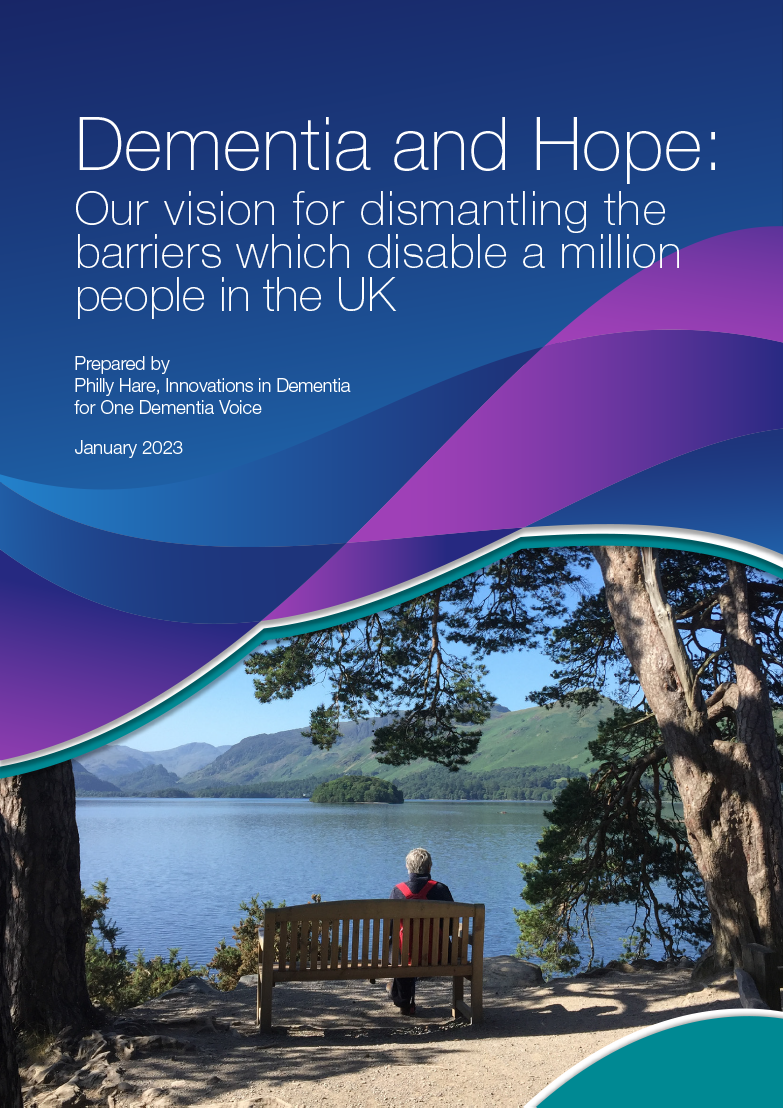
‘Dementia and Hope’

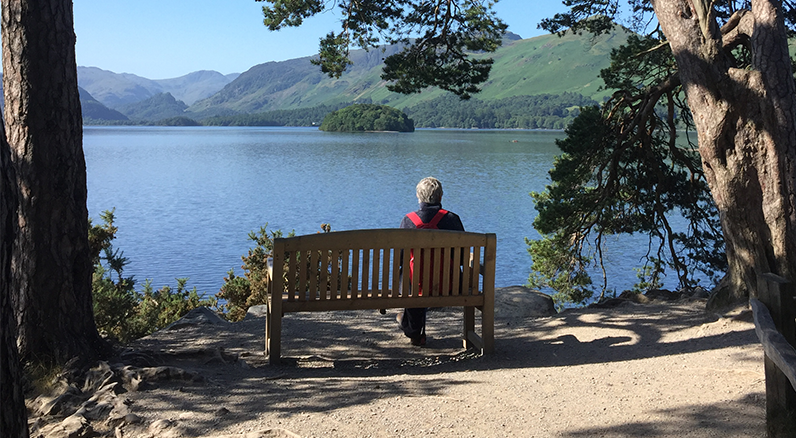
There will soon be over a million people living with dementia in the UK – and each and every one of them is disabled, not only by the symptoms and challenges of the condition itself, but by many unnecessary societal and environmental barriers. While others are working on treatments and cures which may help those affected in the future, we are committed to tackling the non-medical barriers they face in the here and now. We believe that we all have the power to change or minimise these barriers, by making adjustments both to the physical environment, and to our attitudes and behaviours, and by adopting a rights-based approach. And we know that we can do this – if we all work together.

In the past couple of years, Innovations in Dementia has collaborated with 8 other major dementia organisations, who have come together as One Dementia Voice (ODV). We have produced a vision based on what people with dementia have told us about these barriers, and what we know about their human rights.

Our vision is that:

  • We must focus not only on the medical aspects of dementia, but also on the many other barriers which disable those affected.
  • We must address these societal and environmental barriers proactively, thinking more about rights, citizenship, inclusion and equality.
  • In this way we can each play our part in bringing more hope and meaning to the lives of those of us who live with this condition.


Our vision is about hope, enablement and positivity. Recognising dementia in terms of disability rights and citizenship can empower, and give hope to, those who are diagnosed and their families.

This approach helps us all to focus on how the disabilities associated with dementia connect with social, attitudinal and environmental factors; with the strengths, resilience and abilities of people with dementia themselves; and with the principles of solidarity and inclusion. It should help people
with dementia to access everything that others, with or without disabilities, access – and to remain active citizens and participants in their own lives. Society can also learn from them what the barriers are, and redouble its efforts to minimise them through what the law calls reasonable adjustments /accommodations.

The vision has been endorsed and tested by the nine ODV member organisations in the course of 2022. While progress inevitably takes time, it has influenced their strategic thinking, their messaging and many practical aspects of their work.

We now wish to roll out this vision much more widely. We invite YOU to take it on board and implement it within your own organisation and work.

You can access the new document ‘Dementia and Hope’ here . It sets out our starting point and the key benefits of the approach. It addresses many frequently asked questions (FAQs) and provides suggestions on how to embed ‘Dementia and Hope’ into your organisation. There are also many personal stories and examples of how ‘reasonable adjustments’ can and should be made for people with dementia. At the end (on Page 60) you will also find links to several films which we hope you will watch with your colleagues.

Do let us know your response to the vision and what you decide to do to make it reality. This is something that can unite us all!

Dementia and Hope

Philly Hare
Co-director, Innovations in Dementia


What captures the essence of DEEP?

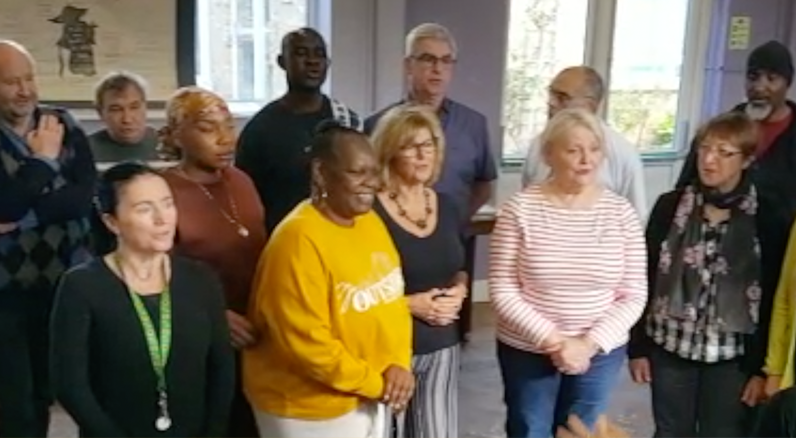
The wonderful folk at Mindcare YODA adding their voices


As we look back over the last 10 years, there’s a lot to think about.

….but probably the words that most readily  spring to mind aren’t the ones we would have imagined when we started.

Warmth

Friendship.

Love.

None of which lend themselves to the usual metrics of evaluation. What’s the score on the love-ometer?

But we see it every day in our work with people with dementia.

So when I was asked to put together a piece of music celebrating DEEP, it was to this that I turned.

My main inspiration came from a Dementia Diary recorded by Dory, in which she reads from the wonderful “The Boy, the Mole, the Fox and the Horse: by Charlie Mackesy.

You can hear Dory’s Dementia Diary here:

https://dementiadiaries.org/entry/14249/dory-reads-chapter-4-of-the-boy-the-mole-the-fox-and-the-horse/?highlight=horse

These words in particular captured so perfectly what for me has been the most amazing thing about DEEP:

“Sometimes I feel lost,” said the boy.
“Me too,” said the mole. “But we love you and love brings you home”

“You fell, but I’ve got you,” said the horse.
“Everyone is a bit scared,” said the horse.
“But we are less scared together.

What beautiful words, especially:

“I’ve Got You”

It’s the support, encouragement, inspiration, solidarity, warmth, friendship and love between people with dementia that defines the very essence of DEEP for me. It’s been the most remarkable, largely unmeasurable, and absolutely uncontainable outcome of all.

It’s for this reason that ‘I’ve Got You’ become my inspiration, and working title for the music.

I’ve been working with Chris Norris and Paul Hitchmough to put together a musical celebration of DEEP.

They have both provided musical inspiration and the bedrock of the piece.

Not only that, but 80 individual people with dementia have also contributed with audio and video recordings of “I’ve got you’

Not only that but a mass meeting in Northern Ireland all saying it in perfect unison.

…..not only that but three singing groups have lent their lungs to the cause.

You can watch ‘I’ve Got You’ here:

Please share as much as you can….

Now where did I put my Love-ometer?

Steve Milton
Co-director, Innovations in Dementia